As GLP-1 use expands, researchers look for answers

David Arterburn is leading research to help patients and clinicians navigate the rapidly changing GLP-1 landscape
David Arterburn, MD, MPH, is busy these days — exceptionally busy. As a longtime obesity researcher and senior investigator with Kaiser Permanente Washington Health Research Institute (KPWHRI), Arterburn has had a front-row seat to the rapid rise and proliferation of GLP-1 medications for weight loss and a host of other health conditions in recent years.
“These drugs are blockbusters. The amount of weight loss and potential health improvement here is beyond what we've seen before,” he said. “You kind of hope that something like this happens while you're doing research in your career. It's very exciting, and there is lots to study, but it's also like drinking from a firehose.”
And this firehose is providing a deluge of research questions, data, and tantalizing potential uses for these medications — often without the benefit of traditional research trials. For Arterburn, this has meant not only leading research to answer pressing questions about GLP-1s, but also devising best practices for studying these medications and supporting patients and clinicians during what The New York Times has called the “great American GLP-1 experiment.”
A whirlwind with no precedent
Arterburn’s prior focus as an obesity researcher was on weight-loss (bariatric) surgery. This started changing in 2021 when the Food and Drug Administration approved Wegovy as a treatment for obesity. Previously, Ozempic and most other GLP-1s (shorthand for glucagon-like peptide-1 receptor agonists) had only been approved to treat Type 2 diabetes.
“Wegovy was something different. That’s when I realized we're going to have to pivot and start really studying this,” he said. “Since then, it's never been a dull moment.”
In the last 5 years, the development, rollout, and adoption of these drugs has been unprecedented, Arterburn said. He noted that there have been blockbuster drugs before, such as statins for cholesterol and SSRIs (selective serotonin reuptake inhibitors) for depression. However, the demand for GLP-1s has far outstripped that of other medications, driven in part by “off label” use of these drugs for an array of conditions, including binge eating disorder, substance use disorders, and polyendocrine metabolic ovarian syndrome (previously known as polycystic ovary syndrome). People are also increasingly procuring GLP-1s not from their doctors but through telehealth companies and other third-party vendors that offer lower-cost versions via compounding pharmacies.
“The third-party prescribers have proliferated — we didn't do that for statins, we didn't do it for SSRIs. So that whole context is brand new,” Arterburn said. “It's been a whirlwind of figuring out how to navigate all of this from a research standpoint but also clinically.”
Leveraging real-world evidence
With GLP-1 use expanding and evolving rapidly outside of traditional research settings, scientists have turned to real-world data to answer pressing questions about these medications.
“We can't afford to do clinical trials for all these topics because they are expensive and take a long time to generate evidence,” Arterburn said. Analyzing existing data on GLP-1 use — from insurance claims, electronic health records, and large health databases — offers a more efficient approach. It can also provide a better indication of how people use and respond to these medications in the real world. But observational data like this presents its own challenges.
“It's possible to conclude the wrong thing when you're looking at observational data,” said Arterburn. Unlike randomized clinical trials, observational studies don’t randomly assign people to treatments. This makes it more likely that differences in people’s health, lifestyle, income, and other socioeconomic factors — known as confounders — may influence the findings.
So how can researchers account for confounders and produce reliable findings from real-world GLP-1 data? To help answer this question, Arterburn was tapped by the National Institute of Diabetes and Digestive and Kidney Diseases to co-chair a workshop of experts exploring best practices for leveraging real-world evidence on GLP-1s.
“It was a real tour de force of people working in the field,” Arterburn said. “We had 2 different aims: First, to talk about how to use real-world data to inform policy and clinical decisions. And the second part was really diving deep into the methods about how to conduct rigorous real-world data studies. I think we accomplished both of those goals and also ended up with a huge laundry list of research problems that we need to solve, which hopefully will guide others to do good research in this space.”
The workshop report, which was recently published in the Annals of Internal Medicine, summarizes these research problems in an extensive table of GLP-1 research gaps and opportunities.
Arterburn noted that Kaiser Permanente, as an integrated health care organization, is uniquely positioned to help address many of these research topics.
“We integrate care and coverage, which affords us unique access to data compared to a lot of health insurance companies and large databases,” he said. While other data sources have part of the picture — such as insurance claims data on medication use or data from patients’ electronic health records — Kaiser Permanente has a more complete picture for its members, often over many years or even decades.
“And that is superior generally for capturing the information you need to help address confounders in real-world data,” Arterburn said.
Answering real-world questions
With Kaiser Permanente’s rich data resources and a network of collaborators, Arterburn is helping to answer several important GLP-1 questions.
He is currently leading 3 projects funded by the National Institutes of Health. One is focusing on building a roadmap for equitable access to GLP-1 medications. The other 2 are examining health outcomes from GLP-1s, such as cardiovascular outcomes and complications from diabetes. This is an important area to study, Arterburn noted, as many existing GLP-1 trials look at weight loss as the primary outcome — but weight loss alone may not always indicate better health. One of these projects is comparing GLP-1s and other anti-obesity medications, while the other is comparing these medications to bariatric surgery for Type 2 diabetes.
“A really important question for people with severe obesity and diabetes is, ‘What’s going to be the best treatment for me long term?’” he said. “We’re on the cusp of doing those analyses. It’s very exciting.”
Arterburn’s GLP-1 research portfolio also includes a genetics study testing a model to predict who will do well on GLP-1 medications. This builds on work by the Mayo Clinic and could lead to a more personalized approach to treatment. “We could say, ‘This medication looks like something that you're going to do very well on, and this looks like something you're probably not going to do as well on,’” Arterburn explained.
Supporting care teams and patients
Another important facet of Arterburn’s work is helping Kaiser Permanente Washington clinicians and care teams navigate the rapidly changing GLP-1 landscape. That work has intensified with the recent launch of the Medicare GLP-1 Bridge program, an 18-month pilot that expands GLP-1 coverage to many Medicare Part D recipients, including people who have obesity or who are above a healthy weight and have certain health conditions, such as prediabetes, or a previous heart attack or stroke.
About 25% of Kaiser Permanente Washington members are covered by Medicare, and more than a third of those members may be eligible for GLP-1 medications under the program, Arterburn said. To prepare for the launch, Arterburn has been part of weekly meetings led by pharmacy and primary care teams to develop strategies for managing the increased demand for GLP-1s and supporting patients and providers.
Central to this effort is a collaboration with KPWHRI’s Center for Accelerating Care Transformation (ACT Center). Working with care delivery leaders, Arterburn and his ACT Center colleagues are developing tools within Epic — Kaiser Permanente Washington’s electronic health record — to streamline GLP-1 prescribing and follow-up in primary care.
“When a patient expresses interest in the GLP-1 Bridge program, a lot of information needs to come together,” Arterburn said, noting that these treatments are now indicated for 12 different conditions under the program. “If the provider needs to look through the electronic health record to pull all this together, it is a lot of work. We're creating Epic-based tools so providers can easily find this information.”
In addition to assisting providers in assessing patients’ eligibility for GLP-1 treatment, the tools will also help manage refills, dose changes, and monitoring between visits.
Kaiser Permanente Washington is ahead of the curve with these efforts. “I don't think other health systems have built out Epic in the same way that we're doing,” Arterburn said. “It's going to be a big benefit to primary care in terms of reducing their workload and making it a little bit easier to do the right thing for the patient.”
The team is also developing tools to connect patients taking GLP-1s with support services, including nutrition counseling, health coaching, physical activity guidance, and weight-management classes.
“These are really important aspects of whole-picture care — not just prescribing these drugs and sending people off,” Arterburn said. “We worry that people who are taking GLP-1s from third-party vendors are not getting that full wrap-around care.”
No slowdown in sight
So does Arterburn think the GLP-1 research firehose will slow to a more manageable stream any time soon? Probably not.
“There’s continued innovation and change,” he said. “I think it's probably going to be like this for at least another 5 years and maybe another 10 years.”
Arterburn noted that researchers also have a lot of practical questions to answer about how people should use GLP-1s over time, including dosing, tapering, maintenance, switching medications, lifestyle support, side effects, and safety, particularly for older adults. They also need to better understand how cost, shared decision-making, long-term adherence, health outcomes, and patient characteristics shape who benefits most from these medications. And, of course, the pharma pipeline continues to produce new GLP-1 options, including combined formulations and pills that offer an alternative to the usual injections.
“It's a little nutty and kind of exhausting,” Arterburn said with a laugh. “But it’s also very exciting to be part of this research, which has the potential to benefit large populations. And I'm getting ready to go on vacation, so that's good.”
By Sophie Ramsey

Featured
Researcher
David E Arterburn, MD, MPH
Senior Investigator
Access researcher directory
News

Filling evidence gaps on obesity treatment
Several new grants will fund research on effectiveness, safety, and equitable use of anti-obesity medications.
Live healthy

Comparing different types of bariatric surgery: What’s right for you?
Based on their studies, KPWHRI researchers explain the risks and benefits.
New findings
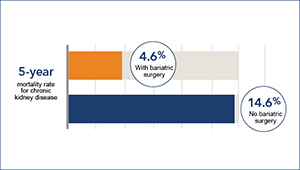
Is bariatric surgery helpful in chronic kidney disease?
David Arterburn and colleagues find that bariatric surgery is linked to lower death risk in persons with obesity and CKD.
Live healthy

What is shared decision-making?
An explanation from KPWHRI researchers about discussing treatment options with a medical provider.
Visit the ACT Center
Moving research into action, together
KPWHRI’s Center for Accelerating Care Transformation improves health for people and communities by streamlining the path from research to practice.