
Brian Williamson, PhD

“Combining prediction models, including machine learning and artificial intelligence, with rigorous statistical methods can make more accurate and efficient use of data. This will enable quicker access to affordable, high-quality care.”
Brian Williamson, PhD
Associate Biostatistics Investigator, Kaiser Permanente Washington Health Research Institute
Affiliate Investigator, Biostatistics, Bioinformatics, and Epidemiology Program, Vaccine and Infectious Disease Division, Fred Hutchinson Cancer Center
Affiliate Assistant Professor, Department of Biostatistics, University of Washington
Brian.D.Williamson@kp.org
206-287-2024
Personal webpage
Biography
Brian Williamson, PhD, is a biostatistician with expertise in statistical epidemiology, semiparametric and nonparametric estimation theory, and high-dimensional estimation and prediction. He is interested in developing robust procedures for statistical inference when machine learning is used to address problems in public health, and in working toward accessible, affordable, high-quality healthcare for everyone. A central theme of his research is using prediction models (including machine learning and artificial intelligence) to make more accurate and efficient use of electronic health records data for research and clinical care.
Before joining Kaiser Permanente Washington Health Research Institute, Dr. Williamson completed his postdoctoral research training at the Fred Hutchinson Cancer Research Center. During his time at Fred Hutch, Dr. Williamson developed statistical methods to address issues arising in the development of biomarker panels for use in risk prediction, screening, and diagnosis. Dr. Williamson also collaborated with researchers from the Women’s Health Initiative to assess the utility of metabolomic biomarkers for predicting breast and colorectal cancer; with researchers from the HIV Vaccine Trials Network (HVTN) to aid in selecting candidate broadly neutralizing antibody regimens to advance to HIV prevention clinical trials; and was a part of the Coronavirus Prevention Network Biostatistics Team.
Dr. Williamson received his PhD in biostatistics from the University of Washington. His dissertation focused on a general framework for performing inference on model-free variable importance measures. With colleagues from the HVTN, he used this framework to identify features of the HIV viral genome that may be important in predicting viral susceptibility to the broadly neutralizing antibody VRC01.
At KPWHRI, Dr. Williamson collaborates on projects across a range of research areas including mental health, pragmatic clinical trials, and drug and vaccine safety and effectiveness.
Recent Publications
Shaw PA, Gruber S, Williamson BD, Desai R, Shortreed SM, Krakauer C, Nelson JC, van der Laan MJ A Cautionary Note for Plasmode Simulation Studies in the Setting of Causal Inference 2026 Aug;45(18-19):e70676. doi: 10.1002/sim.70676. PubMed
Hall C, Wellman R, Cruz M, Shortreed SM, Simon GE, Williamson BD, Yeargans R, Ahmedani BK, Boggs JM, Coleman KJ, Daida YG, Lynch F, Rossom R, Sterling S, Coley RY Validation of a self-harm prediction model in black youth seeking outpatient mental health care 2026 Jul 13 doi: 10.1093/aje/kwag162. Epub 2026-07-13. PubMed
Hsu C, Piccorelli AV, Green BB, Arthur KC, Becker M, Berry B, Binion B, Derus A, Gachuiri M, Hansen K, Koné A, McCracken C, McDonald B, Nisotel L, Senturia K, Volney J, Wilson KB, Williamson BD Efficacy of codesigned COVID-19 booster vaccine promotion materials for long-term care staff: a cluster-randomized trial 2026 Jun 25;26(1) doi:10.1186/s12889-026-28069-7. doi: 10.1186/s12889-026-28069-7. Epub 2026-06-25. PubMed
Williamson BD, Cronkite DJ, Yu O, Ramaprasan A, Fuller S, Covey J, Kiniry E, Park D, Winter R, Whitaker J, McLemore MF, Wittayanukorn S, Stojanovic D, Zhao Y, Dutcher S, Carrell DS, Jackson LA, Nelson JC, Smith JC Identifying anaphylaxis using weakly-supervised prediction models and natural language processing 2026 Jun 17 doi: 10.64898/2026.06.09.26355005. Epub 2026-06-17. PubMed
Gray SL, Piccorelli AV, Hart LA, Cook AJ, Williamson BD, Balderson BH, Phelan EA Substitution Patterns After Discontinuation of CNS-Active Medications in Older Adults in Primary Care 2026 Jun 11 doi: 10.1111/jgs.70514. Epub 2026-06-11. PubMed

News

KPWHRI begins new phase of flu surveillance
KPWHRI receives $10 million to continue vaccine effectiveness research for flu, COVID-19, and other respiratory diseases.
Vaccine Safety

Biostatisticians track COVID-19 vaccine safety
Dr. Jennifer Nelson explains how KP scientists are helping the CDC and FDA keep an eye out for rare adverse events.
mental health
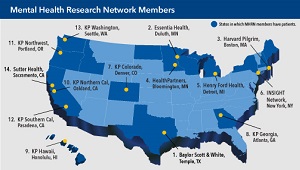
$10 million to expand Mental Health Research Network
NIMH funding will enable the MHRN to conduct larger studies in integrated health systems on topics that matter most.