
Susan Shortreed, PhD

“By using rich data sources such as electronic health records, we can begin to identify which treatments will work best for which people.”
Susan M. Shortreed, PhD
Senior Biostatistics Investigator, Kaiser Permanente Washington Health Research Institute
Affiliate Professor, Department of Biostatistics, University of Washington
Susan.M.Shortreed@kp.org
206-287-2088
Biography
Susan Shortreed, PhD, uses statistics and machine learning methods to address health science problems, with a special emphasis on analyzing complex longitudinal data. She develops and evaluates statistical approaches for observational data and works to improve the design and analyses of studies that use data collected from electronic health care records. She led a project to develop statistical methods for constructing personalized treatment strategies using data captured from electronic health records.
Dr. Shortreed earned her PhD in statistics from the University of Washington. Then she spent two years in the Department of Epidemiology and Preventive Medicine at Monash University in Melbourne, Australia, and two years in the School of Computer Science at McGill University in Montreal, Canada. Dr. Shortreed has collaborated with scientists in a broad range of areas including alcohol use, cancer screening, and medication safety. She now works alongside researchers in mental and behavioral health, evaluating and comparing treatments for chronic pain and depression, and interventions to prevent suicide. Dr. Shortreed is the Analytic Methods Core Lead the Mental Health Research Network, helping to design studies to address important public health concerns, such as determining which antidepressant medications work best for which patients and developing risk prediction algorithms to identify individuals who may be at increased risk for suicide.
Dr. Shortreed is also an affiliate professor of biostatistics at the University of Washington School of Public Health. She served on the executive board for the American Statistical Association’s Mental Health Statistics Section and the editorial boards for Observational Studies and Biometrics.
Research interests and experience
-
Biostatistics
Design and analysis of studies that use data collected from electronic health records; analysis of complex longitudinal data; methods for constructing personalized treatment strategies, computational statistics and algorithms; machine learning; variable selection methods.
Medication Use & Patient Safety
Biostatistics; machine learning; using data collected from electronic health records to study rare adverse events; opioid safety; medication safety in pregnancy.
-
Mental Health
Biostatistics; treatment for chronic depression; suicide prevention; developing personalized treatment strategies; developing risk prediction models.
Recent publications
Pocobelli G, Hyun N, Shaw PA, Harrington LB, Connolly JG, Ramaprasan A, Desai RJ, Dutcher SK, Lee H, Li Y, Zhang M, Apata J, Toh S, Shortreed SM Empirical application of missing data methods to address confounding in health insurance claims-based analyses using electronic health records available on a subset: an example from the Food and Drug Administration's sentinel system 2026 Aug 14 doi: 10.1093/aje/kwag198. Epub 2026-08-14. PubMed
Shaw PA, Gruber S, Williamson BD, Desai R, Shortreed SM, Krakauer C, Nelson JC, van der Laan MJ A Cautionary Note for Plasmode Simulation Studies in the Setting of Causal Inference 2026 Aug;45(18-19):e70676. doi: 10.1002/sim.70676. PubMed
Galanter N, Shortreed SM, Moodie EEM Adjustment set selection for estimating optimal treatment rules under confounding 2026 Jul 23 doi: 10.1037/met0000812. Epub 2026-07-23. PubMed
Hall C, Wellman R, Cruz M, Shortreed SM, Simon GE, Williamson BD, Yeargans R, Ahmedani BK, Boggs JM, Coleman KJ, Daida YG, Lynch F, Rossom R, Sterling S, Coley RY Validation of a self-harm prediction model in black youth seeking outpatient mental health care 2026 Jul 13 doi: 10.1093/aje/kwag162. Epub 2026-07-13. PubMed
Wartko PD, Fuller S, Bastarache L, Shortreed SM, Nickel KB, Durkin MJ, Osmundson SS, McAteer S, Butler AM, Dublin S Patterns of Antibiotic Utilization and Bacterial Susceptibility of Prenatal Urinary Tract Infections 2026 Jun 29 doi: 10.1177/15409996261463319. Epub 2026-06-29. PubMed
Williamson BD, Moodie EEM, Simon GE, Rossom RC, Shortreed SM Inference on summaries of a model-agnostic longitudinal variable importance trajectory with application to suicide prevention 2026 Jun;20(2):1340-1363. doi: 10.1214/26-aoas2186. Epub 2026-06-22. PubMed
Ralston JD, Anderson ML, Ng J, Bashir A, Ehrlich K, Burns-Hunt D, Cotton M, Hansell L, Hsu C, Hunt H, Karter AJ, Levy SM, Ludman E, Madziwa L, Omura EM, Rogers K, Sevey B, Shaw JAM, Shortreed SM, Speight J, Sweeny A, Tschernisch K, Tschernisch S, Yarborough L Preventing Severe Hypoglycemia in Type 2 Diabetes: Randomized Controlled Trial of Proactive Care With Versus Without Psychoeducation 2026 May 12 doi: 10.1007/s11606-026-10491-7. Epub 2026-05-12. PubMed
Zou R, D Williamson B, M Shortreed S, Coley RY Validation of a Risk-Prediction Model in the Presence of Outcome Misclassification 2026 Apr;45(8-9):e70377. doi: 10.1002/sim.70377. PubMed
Simon GE, Wellman R, Shortreed SM, Johnson E, Sterling SA, Coleman KJ, Ahmedani BK, Yaseen ZS, Mosholder AD Predicting and differentiating opioid and non-opioid drug poisonings using health records data 2026 Mar;182:209861 doi:10.1016/j.josat.2025.209861. doi: 10.1016/j.josat.2025.209861. Epub 2025-12-22. PubMed
Williamson BD, Krakauer C, Johnson E, Gruber S, Shepherd BE, van der Laan MJ, Lumley T, Lee H, Hernández-Muñoz JJ, Zhao F, Dutcher SK, Desai R, Simon GE, Shortreed SM, Nelson JC, Shaw PA Assessing Treatment Effects in Observational Data With Missing Confounders: A Comparative Study of Practical Doubly-Robust and Traditional Missing Data Methods 2026 Feb;45(3-5):e70366. doi: 10.1002/sim.70366. PubMed

Research

COVID risks not meaningfully greater with estrogen-containing medications
Oral contraceptives, hormone therapy not linked to more severe COVID outcomes.
Research

A medication that can relieve symptoms of psychosis is underused
Study finds that many patients who might benefit from clozapine don’t receive it.
Research

New findings on treating hypertension in pregnancy
A study led by Dr. Sascha Dublin finds similar outcomes for 3 hypertension medications, filling an evidence gap.
COVID-19

Greater infection risks linked to COVID-19 disparities
New work by Susan Shortreed, PhD, finds infection risks drive worse outcomes for some racial and ethnic groups.
Drugs, diabetes, disparities
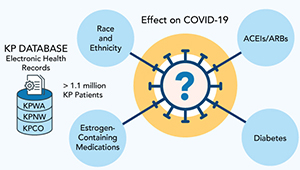
Studying COVID-19 risk and outcomes
Dr. Sascha Dublin tells how studies of KP electronic health record data can improve COVID-19 treatment and prevention.
KPWHRI IN THE MEDIA
Simpler models for predicting suicide risk work comparably to more complex ones
Q&A: Simple machine learning model predicts suicide risk well
Healio Psychiatry, April 12, 2023